

Texas License Plate records reflect more than a century of vehicle registration changes across the state. Early plates featured simple number combinations, with later versions introducing county codes, updated materials, reflective finishes, and specialty designs. Every new release marked changes in transportation, manufacturing, or state requirements. Collectors, vehicle owners, and history enthusiasts often compare older plates with modern versions to see how registration practices, plate styles, and identification standards have changed through different decades in Texas.
Texas License Plate history highlights the steady progression from hand-issued metal tags to standardized plates used on millions of registered vehicles. Color schemes, slogans, numbering formats, and security features changed over time to match state policies and vehicle growth. Historic designs remain popular with collectors, restorers of classic vehicles, and anyone researching registration records. Looking at past plate series provides useful context about how Texas vehicle identification developed into the format used across the state today.
When Did Texas Begin Issuing License Plates?
Texas Plate History began in 1907, when the state started issuing official license plates after creating a statewide motor vehicle registration law. This marked the beginning of the Texas License Record system, allowing registered vehicles to be officially documented and identified across the state. Before 1907, many vehicle owners displayed homemade identification numbers that met local requirements instead of using standardized state plates.
As automobiles became more common, Texas introduced a uniform registration system to identify vehicles and record ownership across the state. This marked the beginning of an organized vehicle registration history, making it easier for public officials to maintain records and identify registered vehicles.
First Official Texas License Plates
The first Texas license plate was issued in 1907 under state authority. These early plates focused on identification rather than appearance, featuring simple numbers without the colorful graphics or slogans found on modern designs. At the time, the state wanted every registered automobile to display an official plate that could be linked to a registration record. This system reduced confusion created by homemade identifiers and created a consistent method for tracking vehicles.
Early Registration Requirements
Vehicle owners had to complete a registration before driving on public roads. The process established an official record for each automobile and connected it with its assigned registration number.
Registration records typically included:
| Registration Detail | Purpose |
| Owner’s name | Identified the legal vehicle owner |
| Vehicle information | Recorded basic details about the automobile |
| Registration number | Assigned a unique identifier to each vehicle |
| Registration fee | Supported administration of the registration program |
These records became more valuable each year as automobile ownership increased across Texas.
Early Numbering Methods
The first issued plates followed a straightforward numbering system instead of today’s county-based or specialty plate formats. Each registered vehicle received its own identification number, helping state officials maintain organized registration records.
Some features of the early numbering process included:
- Numbers were assigned in sequential order.
- Each registered vehicle received a unique plate number.
- Registration numbers matched official state records.
- New registrations received the next available number.
This simple approach worked well during the early years, though later systems changed to support the state’s growing number of registered vehicles.
Materials Used for Original Texas Plates
The original Texas plates were manufactured with durability in mind. Many early examples used porcelain-coated steel, which provided a smooth finish and helped protect the plate from rust and weather exposure.
As production methods improved and vehicle ownership expanded, Texas shifted to pressed steel plates that were easier and less expensive to manufacture in large quantities.
Common materials used over the early years included:
| Material | Why It Was Used |
| Porcelain-coated steel | Improved weather resistance and durability |
| Pressed steel | Lower production cost for larger quantities |
| Embossed metal numbers | Made registration numbers easier to read |
Today, surviving plates from the early 1900s are valued by collectors and museums. They represent an important part of Texas Plate History and show how the state’s vehicle registration system developed during the early automobile years.
Complete Texas License Plate Timeline
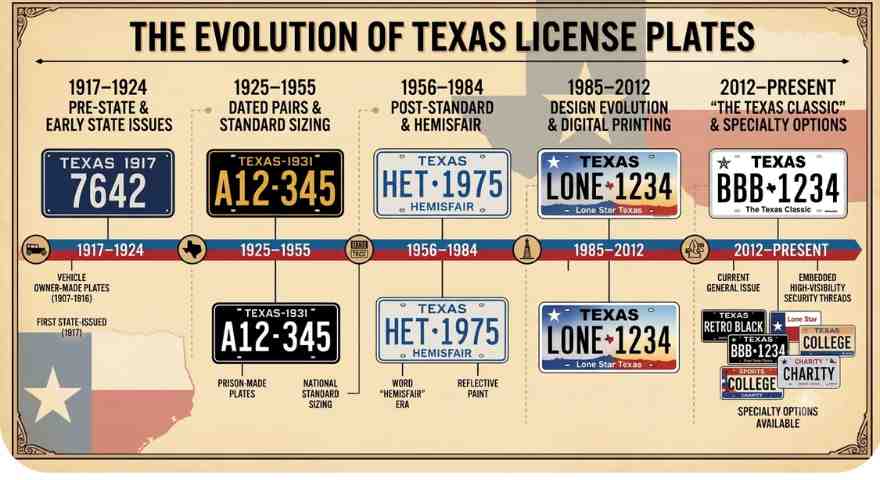
The Texas Plate Timeline began in 1907 with simple state-issued plates and has continued to evolve through new materials, numbering systems, security features, and modern manufacturing methods. Each decade introduced updates that reflected changes in vehicle ownership, production technology, and registration requirements.
The following timeline highlights the major milestones in Texas Plate History, covering design, colors, materials, number formats, registration changes, and manufacturing improvements.
Major Design Changes Throughout History
Texas Historical License Plates have changed significantly since the first state-issued plates appeared in 1907. Improvements in design, materials, visibility, and security have created plates that are easier to read, longer lasting, and better suited for modern vehicle registration.
Shape and Overall Plate Appearance
The shape of Texas Historical License Plates has remained rectangular since the beginning, though the size and layout have changed over time. Early plates varied before Texas adopted the North American standard size of 6 × 12 inches in 1956. This standard improved compatibility with passenger cars, trucks, and mounting brackets produced by vehicle manufacturers. Plate borders became cleaner, spacing between characters increased, and layouts were refined to improve visibility from greater distances while creating a more balanced appearance.
Color Changes
Color has played an important role in the design evolution of Texas license plates for more than a century. During the early years, Texas frequently changed background and lettering colors from one registration year to the next, allowing officers to identify current registrations more easily. As manufacturing improved, the state adopted color combinations that offered stronger contrast and greater readability. Modern passenger plates commonly feature a white reflective background with dark lettering, creating clear visibility during daylight, nighttime driving, and poor weather conditions.
Typography
Typography has evolved alongside improvements in manufacturing technology and vehicle identification standards. The earliest Texas Historical License Plates used simple letters and numbers that focused on basic identification instead of visual consistency. As production methods advanced, character shapes became larger, cleaner, and easier to recognize from longer distances. Modern fonts maintain consistent spacing, uniform proportions, and improved legibility, supporting both manual identification by law enforcement and automated plate-reading technology used by transportation agencies.
Reflective Coatings and Embossing
Reflective materials and embossed characters changed the appearance and performance of Texas license plates during the second half of the twentieth century. Earlier plates relied on painted metal surfaces that became difficult to read after dark or during poor weather. Modern reflective coatings return light from vehicle headlights, making registration numbers much more visible at night. Raised lettering created through embossing adds depth and durability, helping license plates remain readable after years of regular exposure to sunlight, rain, and road conditions.
Security Improvements
Security features have become an important part of modern Texas Historical License Plates as registration fraud prevention has received greater attention. Manufacturing now follows strict production standards that create consistent lettering, spacing, and reflective finishes that are difficult to duplicate. Improved coatings increase durability while helping preserve registration details throughout the life of the plate. These changes support accurate vehicle identification, strengthen registration integrity, and improve confidence in the statewide licensing system used across Texas.
State Slogans
State slogans have become a recognizable part of Texas license plate design and help represent the state’s identity. Earlier license plates focused almost entirely on registration numbers with very little decorative content. Later designs introduced official slogans, including the widely recognized phrase “The Lone Star State,” which continues to appear on many standard passenger plates. Specialty license plates often display different graphics and messages approved by the state, giving motorists more choices while preserving official registration requirements.
County Identifiers
County identifiers have changed throughout the history of Texas license plates as registration systems became more organized. Early vehicle records relied primarily on state and local registration documents instead of clearly displaying county information on every plate. As License Plate Laws evolved, administrative improvements allowed registration records to connect vehicles with specific counties more efficiently. Today, county information is managed through the registration process rather than serving as a permanent visual feature on most standard passenger plates, reflecting the continued modernization of the state’s vehicle registration system.
Materials Used in Texas License Plates Over the Years
Texas Historical License Plates have been produced from different materials since 1907, with each upgrade improving durability and visibility. Manufacturing evolved from porcelain-coated steel to lightweight aluminum and modern reflective plates used on today’s vehicles.
Porcelain
The earliest Texas Historical License Plates often featured porcelain-coated steel, which provided a smooth, glossy finish and helped protect the metal from rust. Although durable for the time, the porcelain coating could chip after years of regular use.
- Used on many early license plates.
- Glossy enamel coating over steel.
- Improved resistance to rust and moisture.
- Now highly collectible among vintage plate enthusiasts.
Steel Plates
Steel became the primary material as vehicle registrations increased across Texas. It supported faster production and allowed manufacturers to stamp raised letters and numbers directly into the plate.
- Strong and durable construction.
- Supported embossed characters.
- Painted finish for weather protection.
- Widely used during the early and mid-1900s.
Aluminum Plates
Texas later adopted aluminum to improve plate performance and reduce weight. The material offered better corrosion resistance and remained durable in different weather conditions.
- Lightweight compared to steel.
- Naturally resistant to rust.
- Longer service life.
- Still used for standard passenger plates today.
Reflective Coatings
Reflective sheeting improved nighttime visibility by reflecting vehicle headlights back toward drivers and law enforcement. This upgrade made license plates easier to identify in low-light conditions.
- Introduced for improved visibility.
- Increased road safety.
- Reduced fading over time.
- Common on all modern plates.
Modern Production
Today’s Texas Historical License Plates are manufactured using advanced equipment that improves quality and consistency while supporting large production volumes.
- Computer-controlled manufacturing.
- Precision embossing techniques.
- Durable protective coatings.
- Consistent size, lettering, and finish.
Interesting Facts About Texas License Plate History
Texas License Plate History includes several unusual plate releases, collectible editions, and record-setting registrations that many drivers never notice. These facts highlight unique moments that helped shape the state’s long history of vehicle identification.
Rare Editions
Some Texas license plates were produced in limited quantities for special events, organizations, or approved programs, making them difficult to find today. Plates with very low registration numbers, discontinued specialty series, and early prototype designs are especially popular among collectors. Their limited availability has made them some of the most desirable pieces in private collections and automotive museums.
- Low-number registration plates.
- Discontinued specialty plate series.
- Limited-production commemorative editions.
Many of these plates become available only through private sales or collector auctions. Their rarity often makes them more valuable than standard passenger plates from the same period.
Short-Lived Designs
A number of Texas plate designs remained in circulation for only a brief period before being replaced by updated layouts or new registration programs. Some specialty designs were retired after limited demand, while others disappeared following administrative changes. These shorter production runs make certain designs much harder to locate today.
Collectors often search for these discontinued plates because they represent small chapters in Texas License Plate History. Their limited production adds historical interest without requiring exceptional age.
Interesting Records
Texas has one of the largest vehicle registration programs in the United States, producing millions of license plates every year. The state now offers hundreds of approved specialty plate options covering universities, military service, charities, professional organizations, and recreational interests. This wide selection makes Texas one of the most diverse specialty plate programs in North America.
- Millions of active vehicle registrations.
- Hundreds of specialty plate choices.
- One of the nation’s largest registration systems.
The continued growth of registration programs reflects the increasing number of vehicles on Texas roads and the demand for personalized registration choices.
Collector Favorites
Collectors often value plates that tell a unique story rather than simply showing age. Specialty plates that were issued for a limited time, unusual serial number combinations, and plates connected to historic events often attract the greatest attention. Condition, originality, and documented history usually have the biggest influence on collector interest.
Many enthusiasts preserve these plates as part of automotive history instead of using them on vehicles. Their collections help document how Texas License Plate History has developed through different generations.
Frequently Asked Questions
Texas license plates have changed considerably since the state’s first registration program began in the early 1900s. Many vehicle owners, collectors, and history enthusiasts have questions about early designs, legal use, and rare editions. The answers below explain important facts about Texas License Plate History, helping readers understand how license plates have evolved over time and why certain historic designs continue to attract interest today.
When was the first Texas license plate issued?
The official Texas Plate History began in 1907, when the state introduced its first government-issued license plates after adopting a statewide motor vehicle registration law. Before that year, many vehicle owners displayed homemade identification numbers that met local requirements. The new registration system assigned unique numbers to registered vehicles, creating a standardized method for identifying automobiles throughout Texas and laying the foundation for the modern registration program.
What did the earliest Texas license plates look like?
The earliest Texas Historical License Plates featured a simple rectangular design with embossed numbers and very little decorative styling. Their main purpose was vehicle identification rather than appearance, so they did not include the graphics, slogans, or specialty themes seen on modern plates. Many early plates used contrasting paint colors that changed by registration year, making them easier for officials to recognize.
Can old Texas license plates still be legally used?
Some Vintage Texas License Plates may still qualify for legal display under Texas rules for classic or antique vehicles, provided they meet state eligibility requirements and receive approval through the appropriate registration process. Most historic plates are preserved as collectibles instead of being used for everyday driving. Owners should always confirm current requirements before displaying an older plate on a registered vehicle.
Why have Texas license plate designs changed over time?
Texas License Plate History reflects more than a century of improvements in vehicle registration, manufacturing technology, visibility, and security. As the number of registered vehicles increased, Texas updated plate layouts, numbering systems, materials, and production methods to improve durability and readability. New specialty plate programs and state branding have also influenced modern plate designs while maintaining clear vehicle identification.
Which Texas license plate design is considered the rarest?
Many collectors consider the earliest Historical Texas Plates, especially porcelain-coated editions from the first years of state registration, among the rarest examples. Limited-production specialty plates, discontinued designs, and low-number registrations are highly valued as well. A plate’s rarity often depends on its production quantity, condition, historical significance, and how many original examples remain available today.